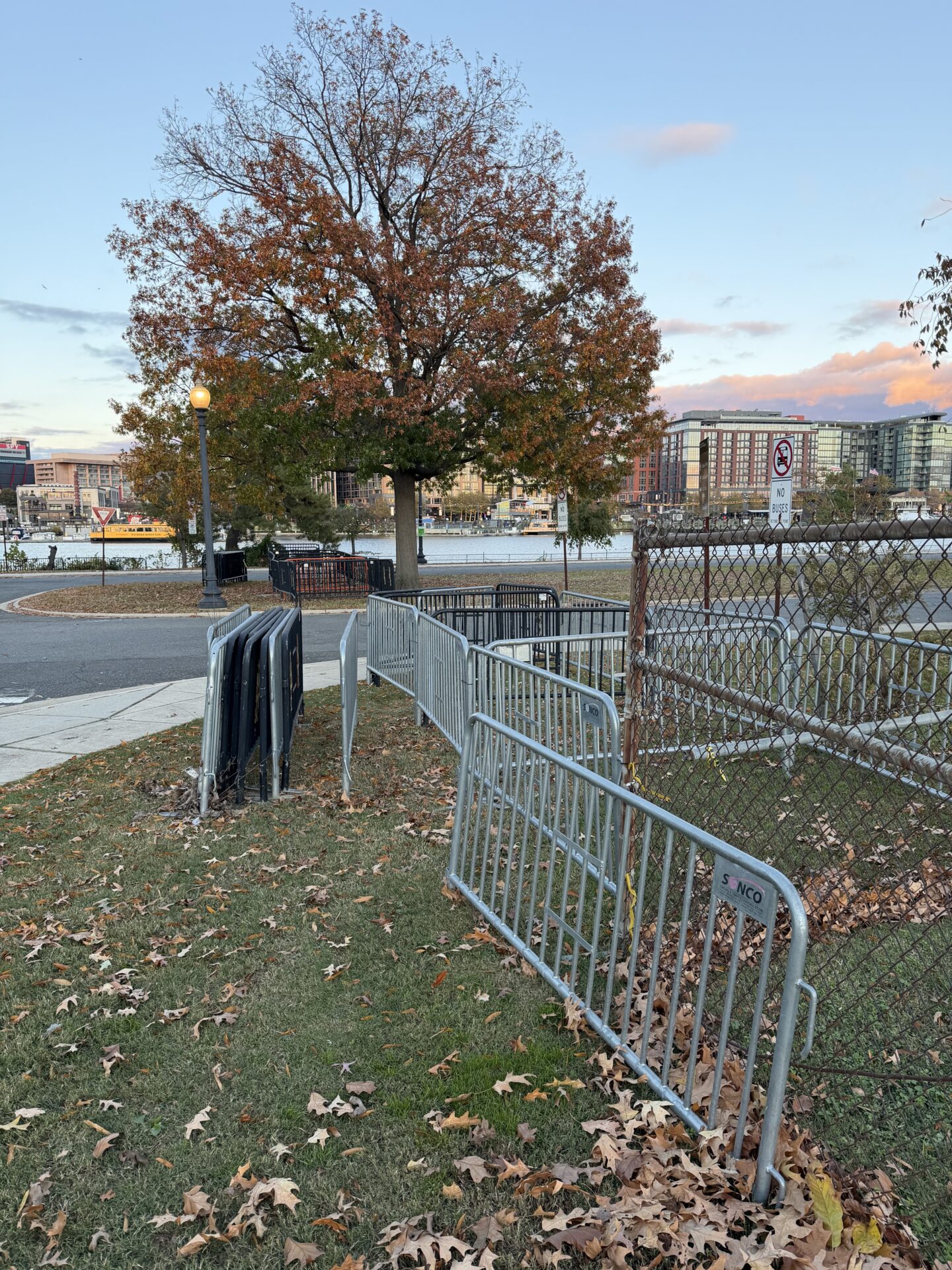
I have been amazed, inspired, disheartened, and genuinely in awe of what I’ve witnessed over the last two days, seeing the democratic process firsthand. Yesterday, I attended the lobby days (you can read about it here.) Today, I attended the court hearing, which began at 10 AM and kept us in the courtroom until 4 PM.
What happened in court?
The Hill has a more detailed article about today’s hearing here. You can also check out this video I posted on Instagram with my observations. At the end of the day, Judge Reyes said she will issue a decision by Saturday at midnight. If you want to follow the outcome, it will be posted on the CourtListener case docket here. In the meantime, the photo headlining this article is from today, Nov 13, showing how the barricades have been placed, ready to shut the park down. The next 48 hours will sure be interesting.
So, besides sitting around and hoping for the best, what else can you do?
I’ve already outlined several recommendations in yesterday’s article linked above. But if you want your voice heard, there are two critical commissions where you can submit public comment: the Commission of Fine Arts (CFA) and the National Capital Planning Committee (NCPC)
During today’s hearing, we repeatedly heard references from all parties (the DOJ lawyers, Judge Reyes, the amazing Democracy Forward legal team and the Cherry Blossom Race organizer’s legal team from Covington & Burling) to “the design concepts submitted to NCPC and CFA.” The design concepts are what makes the upcoming commission meetings particularly important. The Department of the Interior has submitted the designs and would need the green light from those two commissions to move forward. The CFA meeting is next week (Nov 19) and the NCPC meeting is Dec 3. Both of these meetings are open to the public (CFA in person if you want to speak and streaming option available; NCPC will be online due to the ‘high volume of anticipated attendance’).
IT IS ABSOLUTELY CRITICAL THAT THESE TWO COMMISSIONS HEAR FROM THE PUBLIC IN WRITTEN SUBMISSIONS BEFOREHAND AND DURING THE MEETINGS.
Regardless of who you are, how you use Hains Point, or why you think it is special: SHARE YOUR STORY.
The design the government has submitted to these commissions (which you can see on their websites) is 100% golf-focused, eliminating all other uses. If we can demonstrate overwhelming public input showing that East Potomac Park and Hains Point are used for much more than ‘just’ golf, then, call me an optimist, but I personally believe it will make a difference.
I already detailed how you can participate in the Dec 3 NCPC meeting info in my article yesterday (here).
So let’s focus on next week! Commission of Fine Arts — November 19
The Commission of Fine Arts (CFA) is an independent federal agency charged with providing expert advice to the President, Congress, and federal and District of Columbia governments on matters of design and aesthetics affecting the federal interest and preserving the dignity of the nation’s capital. The Commission is composed of seven presidentially appointed experts in relevant disciplines, including art, architecture, landscape architecture, and urban design.
You can find information about its upcoming meetings here. And you can Submit your public comment to the Commission of Fine Arts here. The form asks for project. This one is ‘CFA 19/NOV/26-3’.
Meeting details:
- Date: Thursday, November 19, 2026
- Time: 9 AM
- Location: 401 F Street NW, Suite 312, Washington, DC 20001–2728
The meetings are open to the public. You can find the draft meeting agenda here. Look for agenda item: “CFA 19/NOV/26-3 East Potomac Park Golf Course, 972 Ohio Drive, SW, Washington, DC. Redevelopment of existing golf course. Concept.” Here is the actual design plan submitted for review. (I strongly encourage you to compare this proposal with the other, much more detailed and meticulous plans also appearing on that day’s agenda. Those plans include specific public comment periods and analysis of public usage.)
Unfortunately, I won’t be able to attend, but I have submitted a written comment, which I’ve included below to share as just one example and hopefully inspire you to share your story. Whether you submit three lines, three paragraphs, or three pages, I believe the most important thing is that the Commission understands what Hains Point means to our community, how extensively the park is used beyond golf, and just how damaging and short-sighted the current proposal could be.
Please take a few minutes to make your voice heard. You matter. Your history matters. Your voice matters. #strongertogether
Here’s what I submitted:
East Potomac Park: Protecting Cycling, Multi-Use Recreation, Cherry Blossoms, and Miniature Golf
I am a triathlete and President of DC Tri Club, a community of more than 600 athletes across Washington, DC, Maryland, and Virginia. I strongly oppose the proposed redevelopment of East Potomac Park at the expense of its existing public recreational uses, natural environment, and historic character.
East Potomac Park is one of Washington, DC’s most valuable public spaces. Hains Point serves residents, visitors, athletes, families, and community organizations throughout the year. Its value cannot be measured simply by the number of golf holes it can accommodate or the revenue a redevelopment might generate.
The submitted plan appears short-sighted because it does not adequately assess the full scope of existing public use at Hains Point or the consequences of displacing those uses. It gives insufficient consideration to the thousands of residents, athletes, families, and visitors who use the park and its roads throughout the year. Nor does it sufficiently analyze where those users would go, whether alternative facilities could safely accommodate them, or what the loss of this unique recreational infrastructure would mean for public access and safety. A plan that fundamentally changes how this public space functions without fully understanding its existing users and uses raises serious concerns for public welfare.
Improving East Potomac’s golf facilities does not require sacrificing the rest of the park. The course can be modernized within its existing golf footprint—without destroying the surrounding multi-use parkland, eliminating the cycling and running opportunities along Ohio Drive, or sacrificing the iconic cherry blossom experience. We can have excellent public golf while preserving the trees, waterfront access, recreational infrastructure, and shared public spaces that make East Potomac special.
East Potomac Park should remain a public park first and foremost.
1. Hains Point is essential recreational infrastructure
As a triathlete and DC Tri Club president, one of the oldest and largest triathlon clubs in the country, I see firsthand how important Hains Point is to our community. Its uninterrupted perimeter loop offers a rare opportunity for cyclists to train without navigating regular city traffic. It serves beginner cyclists, experienced riders, triathletes, runners, walkers, families, and visitors.
DC Tri Club, celebrating 25 years in 2027, has hosted its Wednesday group ride here for years, along with other training and community events. Members also use the park independently throughout the week. There are dozens of running and cycling clubs that use Ohio Drive as a central training facility on a daily basis. Not to mention, it is an important training destination for people preparing for events such as the Cherry Blossom 10 Mile, Army Ten-Miler, and Marine Corps Marathon.
This is not simply an event venue. The park’s geography, predictable loop, and relatively safe, uninterrupted road access provide recreational infrastructure that nearby streets and parks cannot replicate.
2. East Potomac Park was created for public access and enjoyment
East Potomac Park was created from reclaimed Potomac River mudflats. Between 1912 and 1916, the Army Corps of Engineers constructed the perimeter road, originally called Riverside Drive, to provide public access around the newly created island park.
For more than a century, this landscape has served as a place for public recreation and enjoyment. The question should be how to preserve and improve this historic public park—not how to redesign it around a single recreational use.
3. A public park should serve many communities
East Potomac is shared by cyclists, runners, golfers, picnickers, photographers, anglers, families, and waterfront visitors. These uses coexist. Golf already has an established place in the park.
The miniature golf course—one of the oldest in the country and recently updated—is another beloved public amenity that should be preserved.
A public park should accommodate a diversity of users, not prioritize one group at the expense of everyone else.
4. High-quality public golf and multi-use parkland can coexist
The National Links Trust (NLT) has articulated a community-centered vision for municipal golf: accessible, affordable, high-quality facilities for the public.
NLT co-founder Mike McCartin learned to play golf at East Potomac as a child and later wrote his master’s thesis, “Making a Model Municipal Facility: A Case Study of East Potomac Park Golf Course.” The NLT team also brings significant golf expertise, including world-class architect Tom Doak, whose work includes Pacific Dunes in Oregon, Ballyneal in Colorado, Barnbougle Dunes in Tasmania, and Cape Kidnappers in New Zealand. He has six courses ranked among the top 100 in the world according to the March 2021 Golf Magazine “Top 100 Courses in the World” list.
There is an opportunity to build on this vision and deliver excellent public golf without sacrificing the surrounding parkland. Modernizing the course within its existing footprint can support high-quality, affordable golf while protecting the trees, recreational loop, and other community uses.
We should not have to choose between great public golf and a great public park.
5. Protect the trees, landscape, and cherry blossoms
The proposal puts approximately 1,600 trees at risk. These trees provide shade, support wildlife, improve the urban environment, and define the park’s character. Mature trees cannot simply be replaced; they take decades to grow.
East Potomac is also part of Washington’s iconic cherry blossom experience. Riding or walking along Ohio Drive beneath the blossoms, with views of the waterfront and monuments, is a special part of living in and visiting this city.
The trees and landscape are not incidental features of the park. They are part of what makes it valuable. I urge the NPS to preserve all approximately 1,600 trees.
6. The proposal does not adequately account for existing park users
The submitted plan focuses overwhelmingly on golf while treating the surrounding parkland and its many users as secondary. The alternatives analysis reinforces this concern.
- Page 53: The side-by-side comparison of alternatives appears to remove or diminish existing multi-use recreational activities, despite the substantial use of Ohio Drive by cyclists, runners, and other visitors.
- Page 55: The suggestion that biking, walking, fishing, and picnicking could be accommodated “as close as feasible” at West Potomac Park or the Tidal Basin does not establish that these locations can safely or practically absorb the displaced users. These locations are not equivalent replacements for Hains Point.
Hains Point’s uninterrupted perimeter loop, predictable conditions, accessibility, and relative separation from city traffic make it uniquely valuable to cyclists—from beginners to athletes training for competition. There is no comparable nearby substitute for this combination of features.
Telling cyclists and runners to go elsewhere overlooks why they use Hains Point in the first place. Relocating these activities also changes the character of the community that has grown around the park.
The ability of golfers, cyclists, runners, families, anglers, and visitors to share the same public space is central to East Potomac’s value. New recreational opportunities elsewhere do not replace what would be lost here.
The plan should be reconsidered to account meaningfully for the full range of people who use and depend on this park.
7. Public parkland should not be sacrificed for a specialized destination
Golf is an established and valued use of East Potomac Park, and investment in its facilities is worthwhile. But improving public golf is different from transforming a multi-use public park into a specialized championship destination.
Public land should deliver the greatest possible benefit to the public. A plan that prioritizes one use while displacing cyclists, runners, families, and other visitors does not meet that standard.
We can invest in better golf facilities, preserve affordability, and work with experienced golf architects without sacrificing the broader park.
8. Recommendations
I urge the National Park Service and decision-makers to:
- Preserve East Potomac Park as public parkland, protecting its historic landscape, waterfront character, approximately 1,600 trees, and mature tree canopy.
- Protect the Hains Point perimeter roadway and recreational loop, ensuring safe, uninterrupted, year-round access for cyclists, runners, walkers, and other park users.
- Preserve the park’s diverse recreational uses and amenities, including cycling, running, walking, fishing, picnicking, community athletic activities, and the historic miniature golf course.
- Evaluate alternatives that modernize and improve the golf course within its existing footprint, building on the National Links Trust’s community-centered vision for high-quality, affordable public golf without unnecessarily removing mature trees, reducing public access, or displacing established recreational uses.
- Require a comprehensive assessment of existing park use, alternatives, and public-safety impacts, including year-round recreational activity, traffic interactions, event use, and the capacity of any proposed alternative locations to safely accommodate displaced users. Meaningfully engage all affected stakeholders, including residents, cyclists, runners, triathletes, families, golfers, and recreational organizations.
Conclusion: Hains Point Is More Than a Golf Course. It Is a Public Promise.
Hains Point is a rare public space where beginners learn, experienced athletes train, families spend time together, visitors enjoy the waterfront, and people from all backgrounds share the same landscape.
As a triathlete and President of DC Tri Club, I know what this park means to thousands of local athletes and to the broader community. It provides not only a place to train, but also a place to connect, challenge ourselves, and enjoy the natural beauty of our nation’s capital.
The National Links Trust’s vision demonstrates that public golf and public access need not compete. We can improve and modernize the golf course within its existing footprint while preserving the rest of the park for the many people who use it.
Please preserve East Potomac Park and Hains Point as a multi-use public park—for today’s residents and for generations to come.
Public parks. Public paths. Public access.